 blog
blog Refitting vs. Relighting: What’s the Best Choice for Your Project?
Anyone looking to make lighting in an existing building more sustainable quickly encounters this question: should we upgrade the existing fixtures (refitting) or replace everything (relighting)? At Multiline, we always evaluate that choice case by case. We don’t just look at the purchase price but at the Total Cost of Ownership (TCO) — including energy consumption, maintenance, flexibility, and lifetime. This blog explains how to make the right decision between refitting and relighting.

Refitting and relighting in a nutshell
-
Refitting: you keep the existing housing or (parts of) the luminaire and replace the internal components.
-
Relighting: you replace the entire lighting system, including fixtures and, if applicable, the controls.
Refitting or relighting can make a big leap in efficiency and comfort. The best choice depends on your current situation — and what you want to achieve in the long term.
Why you should focus on lifecycle rather than purchase price
In many projects, lighting decisions are driven by short-term goals:
- “How much does it cost today?”
- “Does it fit in this phase’s budget?”
- “Can we order and install it quickly?”
Understandable — but rarely the best guideline. Especially in buildings that are used intensively or whose functions evolve over time. With the cheapest options, you often pay the price later through:
- higher maintenance costs,
- limited flexibility,
- premature failures,
- or an installation that can’t adapt to future layouts. Those are important factors in public buildings or offices.
That’s why, at Multiline, we always consider your long-term costs.

TCO: what determines the total cost of lighting?
The total cost of ownership broadly consists of four components:
1) Energy consumption
LED reduces consumption significantly, but the biggest differences often lie in:
- the efficiency of the chosen solution,
- light distribution (how many fixtures are needed),
- and control (daylight regulation, occupancy detection, zoning).
2) Maintenance and serviceability
This is often an underestimated cost factor. Think of:
- accessibility of drivers and components,
- speed of interventions,
- availability of spare parts,
- and the number of different types within one building.
3) Lifetime and future-proofing
A technically sound solution can still become outdated quickly if it doesn’t evolve with:
- changing spaces,
- new standards or expectations around comfort,
- or integration with building management systems.
4) Major works (now or later)
Sometimes a cheap solution seems attractive today but leads to extra costs later — such as reopening ceilings, rewiring, or partial replacements when functions change.
So, the choice between refitting and relighting isn’t just about one intervention; it’s about long-term efficiency and value.

When refitting is the smarter choice
Refitting is particularly useful when:
- the housings of existing fixtures are still in good condition,
- the infrastructure has limitations (e.g. ceiling setup or available connections),
- you want to minimize disruption to building operations,
- or you aim for a circular approach by keeping materials in use as long as possible.
A well-executed refitting can significantly reduce energy and maintenance costs without major construction work — and fits perfectly in a strategy that uses materials and resources responsibly.
Refitting only works if the existing base is worth keeping. If too many parts are worn, or the luminaire isn’t technically suitable for an upgrade, refitting merely postpones the problems.
When relighting is the better choice
Relighting makes more sense when:
- the current installation no longer meets aesthetic standards,
- the fixtures have technical defects,
- you want to invest in a new lighting concept (not just replacement, but improvement),
- you’re rethinking control and zoning,
- or you want to prepare the building for a long next lifecycle.
Relighting is also a strong choice when you treat lighting as a strategic investment: not just delivering a system, but keeping it high-performing for many years. In that approach, serviceability becomes a key design principle.

The Multiline approach: choosing based on performance, not gut feeling
The right decision starts with a clear understanding of:
- your current situation,
- your objectives (energy, comfort, aesthetics, management),
- and the expected payback time.
That’s why we base our projects on a lighting study: our lighting architects map out the energy-saving potential and match it with the feasible actions for your building. This way, the choice between refitting and relighting becomes an informed, data-driven decision.
Want to find out which approach is most cost-effective for your building? We’d be happy to help — get in touch for a non-binding consultation.
Looking for inspiration?
Do you have questions? Would you like more information about our products?
Contact usMore news
-
Multiline Achieves EcoVadis Bronze: “We Are Raising the Bar”
Sustainable business operations require more than good intentions. They demand time, discipline, and collaboration. Over the past months, our team has gone through a rigorous process to consolidate, substantiate, and make our policies and actions measurable. This effort has earned Multiline an EcoVadis Bronze medal, placing us among the top 35%. In this blog, you will discover the concrete actions behind our EcoVadis score.
Read more -
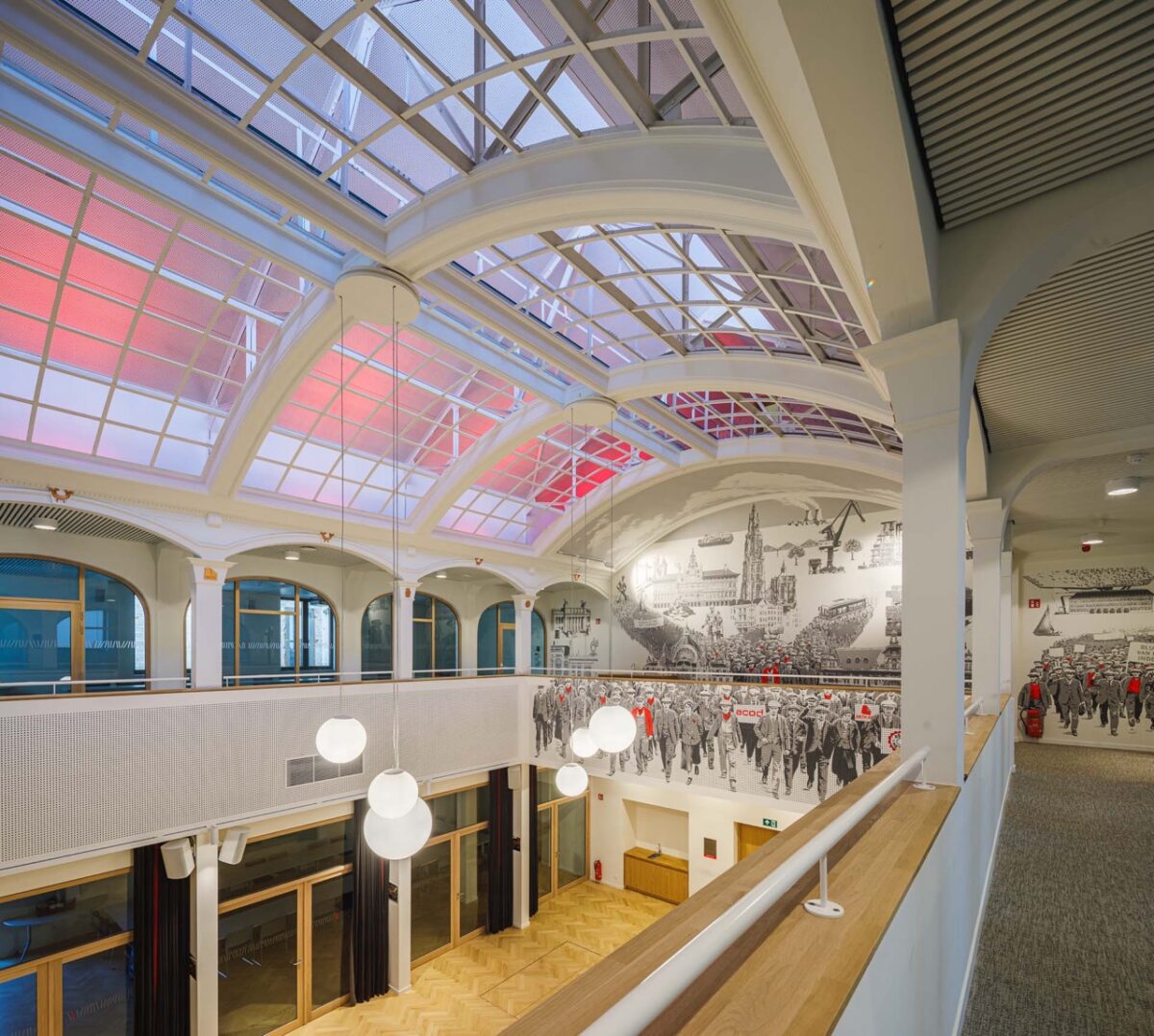
Ingenious lighting implementation in the renovation of the ‘A’ Bondsgebouw in Antwerp
The way light fills a space plays a key role in how a building is experienced. This is especially true in renovation projects, where existing structures can pose challenges in meeting modern comfort and energy standards. This was also the case for the ‘A’ Bondsgebouw in Antwerp, where Multiline provided a lighting solution fully aligned with the building’s character.
Read more -

Architectural lighting in real estate projects: added value for developers
Real estate projects, architecture and finishing define the first impression. Architectural lighting plays a key role in this. Light creates the right atmosphere, highlights features, and gives your project a distinct identity. In this blog, you will discover how, as a developer, you can use architectural lighting to enhance your project with a strong sense of experience and design.
Read more