 blog
blog Dynamic lighting for residential care center Ocura
For residential care center Ocura in Herk-De-Stad, Multiline provided customized light lines for the cafeteria/meeting space. The goal was to create a cozy, interesting perception of the room. This proved to be a difficult yet fascinating challenge for our light architect Evy and our production department. Evy explains how Multiline contributed to this project.
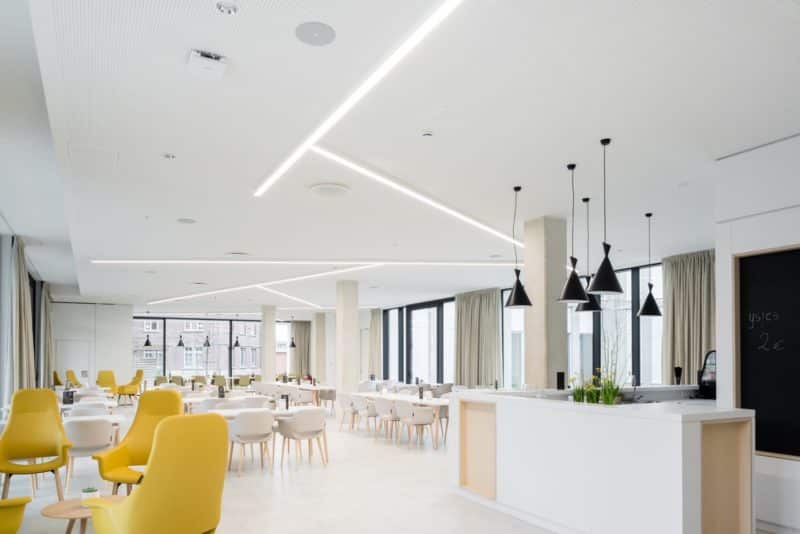
“To add dynamism to a room with a linear design, engineering office Macobo – Stabo came up with the creative solution to bring the space to life with lighting. To achieve this goal, they included luminaires from Multiline in the specifications of the project. The reason: they were already familiar with the high quality of our customized products.”
A complex puzzle
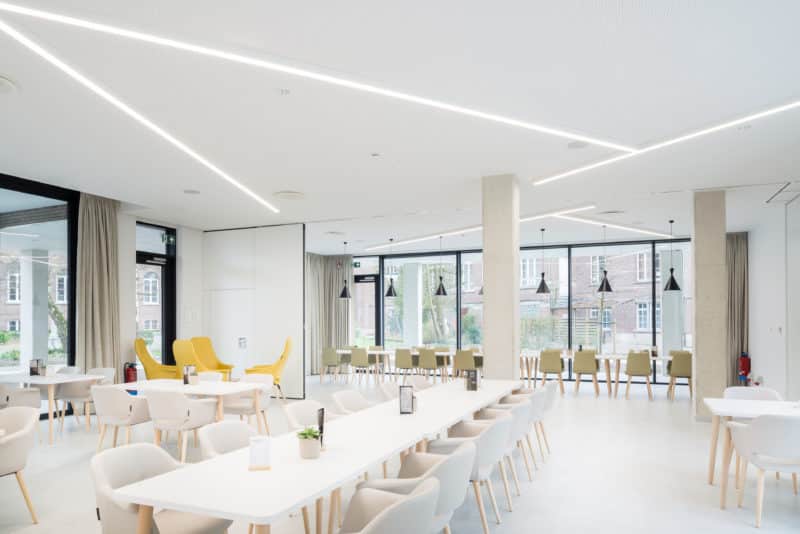
“The design of the light lines was not a simple puzzle,” Evy declares. “In a residential care center, we have to take into account that the rooms are mainly used by the elderly. An important factor is the systematic deterioration of the eyes. In an office environment a light intensity of 500 lx would suffice, but in this case we have to double the amount, as stated in the new European standard EN-12464-1.
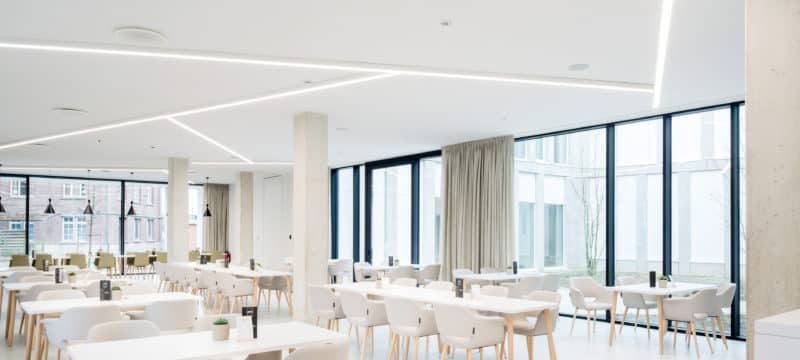
As the light lines are mounted in a criss-cross pattern to the ceiling, it was no easy task to obtain this luminous intensity over the entire room. Every square meter must be adequately lit, dark spots have to be avoided at all costs. The ceiling is also equipped with speakers, vents and smoke detectors, so free space for the light lines is limited. Although the room has large windows, we may not add them to our lighting calculations. Even in the evening and on dark days, there always has to be enough light output.”
High degree of precision
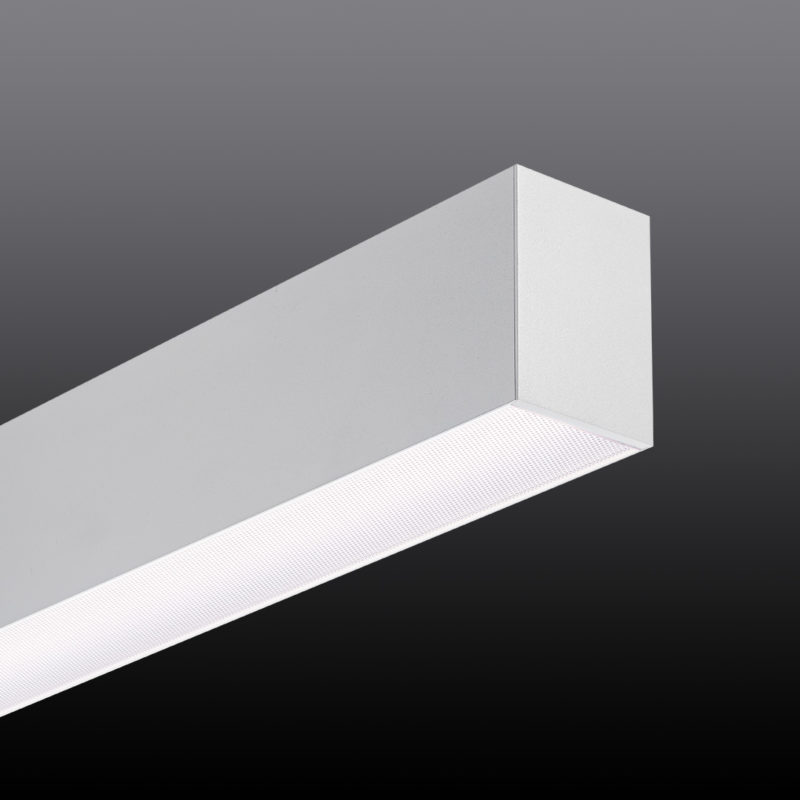
Evy: “We were able to meet these high demands with our surface-mounted Rekta 65 profiles in combination with continuous diffusers. It was important to make accurate production drawings so there would be no dark spots in the diffusers. We have LED inserts in sizes of 7, 14 and 28 cm, which we could optimally use to match the overall lengths of the profiles.”
“Our luminaires are available in more than 200 different RAL colors. For the lighting of the residential care center, we painted the profiles completely white. This color is used to convey a sense of peacefulness and space in the room. Any other color would be too dominant, since the pattern of the light lines is already a big eye-catcher.”
Zhaga certified
“Another advantage of these luminaires is that the LED inserts comply with the Zhaga standard. This means that each insert is individually replaceable by an insert with the same light output from another manufacturer. If a LED insert fails after 10 years, you just have to open the profile at its position and replace the LED insert in question. This is an important added value in terms of durability.”
Looking for inspiration?
Do you have questions? Would you like more information about our products?
Contact usMore news
-

Light lines connecting old and new at WeForm group practice
In the heart of Herselt, a traditional house was thoroughly renovated and extended to create a group practice. With the architectural concept “The Shadow”, a new composition emerged in which the new volume appears to embrace the old one. Multiline delivered the lighting design and produced a bespoke architectural lighting solution.
Read more -

“As a lighting architect, you bring technology and aesthetics together”
As a lighting architect, Lieze translates the plans and ambitions of clients, architects and engineering consultancies into lighting proposals that are both technically sound and aesthetically refined. That is why she values an environment in which quality comes first. “The best thing about my job? The variety. Because so much of our work is bespoke, no two days are ever the same.” In this blog, she explains why she is so proud of her work at Multiline.
Read more -
How does Multiline design bespoke lighting for projects?
A luminaire that integrates naturally into the ceiling rhythm, with a precise finish and light output perfectly tailored to the space… The result often appears self-evident. Yet behind the scenes, bespoke lighting for projects is considered down to the millimetre. In this blog, you will discover how we at Multiline design custom solutions that fully align with both the architectural concept and on-site execution.
Read more